

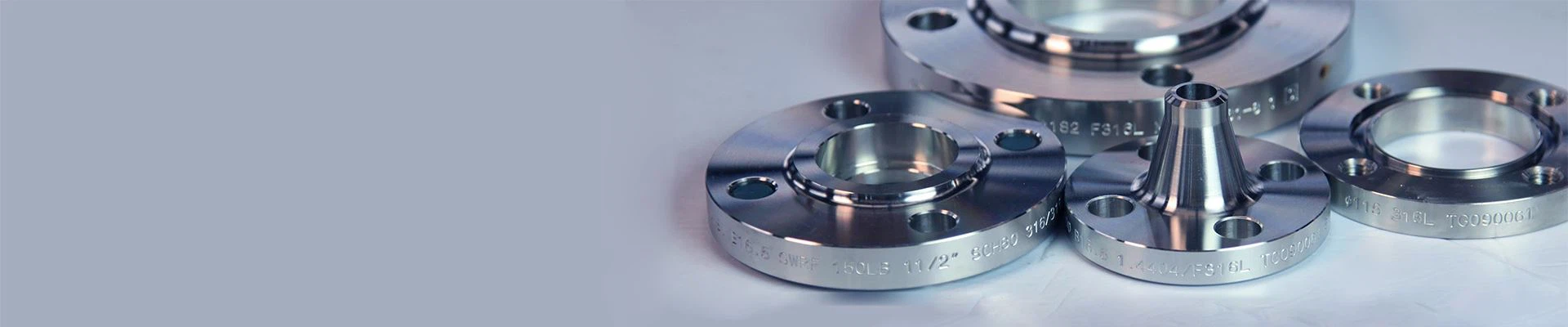


Stainless Steel Flange
Stainless Steel Flange
Your Leading Stainless Steel Flanges Manufacturer in China!
Baoji Yifang Titanium Industry Co., Ltd. is a fastener manufacturer with 15 years of experience in deep processing of titanium, zirconium, stainless steel and their alloy materials.
Strong Production Capacity
It has complete titanium, stainless steel and zirconium flange production lines. The annual output value of titanium flanges is more than 15 million pieces, and has passed ISO9001-2000 quality system certification.
Excellent Design
We provide full solutions that can have your design finished in a matter of hours. We utilise state-of-the-art manufacturing facilities, advanced techniques, and rigorous testing to ensure our products meet the highest industry standards.
Comprehensive Capabilities
Our extensive capabilities include reliable titanium material supply from small to large scale orders, engineering services, manufacturing excellence, and design solutions. We cater to a wide range of industries, including aerospace, defence, medical, chemical processing, and more.
Customized Solution
Our company is committed to providing the highest quality flange solutions and custom manufacturing services, including: custom flanges, neck butt weld flanges, plate flat weld flanges, loose sleeve flanges, blind flanges, custom component manufacturing and Custom metal pipe.
-
![Stainless Steel Plate Flat Welding Flange]() Stainless Steel Plate Flat Welding FlangeRead More
Stainless Steel Plate Flat Welding FlangeRead MoreStandard: ANSI, BS, DIN, GB, ISO, JIS, JPI, ASME. Weight: 27.5. Dimensions: 565*411*32. Minimum
-
![Stainless Steel Threaded Flange]() Stainless Steel Threaded FlangeRead More
Stainless Steel Threaded FlangeRead MoreStandard: ANSI, BS, DIN, GB, ISO, JIS, JPI, ASME. Process: Cold Press. Connection: Welding.


Introduction to Stainless steel Flange
In the past few a long time, stainless steel flange have been broadly utilized in numerous businesses. The greatest advantage is erosion resistance and tall temperature resistance. Austenitic stainless steels like 304 and 316 contain components such as chromium and nickel, which can frame a defensive film on the surface to avoid erosion from destructive substances such as acids, antacids, and salts. In specific, it will not misshape or lose quality indeed beneath tall temperatures and weights.
Stainless steel flange Performance Characteristics
Great erosion resistance
The most noteworthy include of Stainless steel flange is that it is exceptionally corrosion-resistant. This is since stainless steel contains amalgam components such as chromium and nickel, which can shape a defensive film on the surface to avoid erosion from destructive substances such as acids, soluble bases, and salts. Subsequently, this kind of flange can be utilized for a long time in a few cruel situations, such as chemical plants.
High temperature resistance
Stainless steel flange can keep up quality in tall temperature situations and are not effortlessly distorted. Particularly austenitic stainless steels like 304 and 316 can be utilized in tall temperature and tall weight situations, such as steam channels and evaporator systems.
High mechanical quality
Stainless steel flange has tall quality and great hardness, and can withstand tall weight without distortion or breakage. In this manner, stainless steel flange are a exceptionally dependable choice where tall quality is required.
Easy handling
Stainless steel flange are simple to prepare, whether cutting, welding or shaping. It can be handled into different shapes and sizes agreeing to diverse needs to meet distinctive building requirements.
Good fixing
As long as it is introduced appropriately, the Stainless steel flange can fit well with the pipeline, anticipating fluid spillage and guaranteeing the secure operation of the pipeline framework. If combined with a reasonable fixing gasket, the fixing impact will be way better.
The Advantages of Stainless steel flange
Stainless steel flange have ended up a claim to fame component in different businesses due to their run of points of interest, making them the to begin with choice for basic applications. These benefits stem from the special properties of stainless steel, which offer a extend of preferences in execution, solidness and generally framework productivity. In this segment, we’ll take a closer see at the key benefits of stainless steel flange and why they’re so well known.

Erosion resistance
The most unmistakable include of stainless steel flanges is that they are not simple to rust. Since it contains chromium and nickel, a defensive film will be shaped on the surface, which can piece a parcel of erosion such as corrosive, antacid, and salt. Subsequently, stainless steel flanges can too be utilized for a long time in a few chemical plants or places such as the ocean side where rust is simple to occur.

High temperature resistance
stainless steel flanges can moreover keep up a great condition at tall temperatures, particularly materials such as 304 and 316, which will not misshape or gotten to be fragile due to tall temperatures. Subsequently, it is regularly utilized in channels that require to be safe to tall temperatures, such as steam channels or kettle systems.

High strength
stainless steel flanges are exceptionally solid and are not simple to break or distort indeed beneath tall weight. This implies that it is especially reasonable for utilize in places that require to withstand tall weight, such as oil pipelines or characteristic gas pipelines.

Good fixing effect
As long as the establishment is adjust, the fixing impact between the stainless steel flanges and the pipeline is exceptionally great, which can successfully anticipate fluid or gas spillage. With the right fixing gasket, the fixing impact can be advance progressed, particularly in high-pressure or high-temperature frameworks.
Types of Stainless steel Flanges
Stainless steel neck butt welding flange
Presentation: Stainless steel neck butt welding flange has an expanded neck and is associated to the pipe by butt welding. It is as a rule utilized in high-pressure and high-temperature pipeline frameworks.
Advantages:
- Good mechanical strength and stability, suitable for high-pressure and high-temperature occasions.
- Butt welding connection makes the weld smooth and reduces stress concentration.
- Has good durability and safety in the pipeline.
Stainless steel sliding flange
Presentation: Stainless steel sliding flange is associated by embeddings the pipe into the inward gap of the flange and at that point welding. It is more often than not utilized in low-pressure and low-temperature frameworks.
Advantages:
- Simple installation and flexible position adjustment.
- Small welding workload, reducing installation time.
- Suitable for low-pressure systems and relatively low prices.
Stainless steel threaded flange
Presentation: Stainless steel threaded flange has strings interior, which are associated to the pipe by strings and are appropriate for frameworks that do not require welding.
Advantages:
- No welding is required, and installation is convenient and quick.
- Suitable for applications in flammable and explosive environments because sparks during welding are reduced.
- Easy to disassemble and repair.
Stainless steel blind flange
Introduction: Stainless steel blind flange has no through hole and is mainly used to close the port or opening of the pipeline to play a plugging role.
Advantages:
- It can completely seal the end of the pipeline to prevent leakage.
- Easy to disassemble, convenient for pipeline inspection and maintenance.
- High strength, can withstand higher pressure.
Stainless steel glasses flange
Presentation: Stainless steel glasses flange comprises of two circles, one with a gap and one without, associated together by jolts, and is frequently utilized in places where pipelines require to be disengaged frequently.
Advantages:
- It can quickly cut off or connect pipeline fluids and is easy to operate.
- Easy to maintain, especially in systems where flanges need to be replaced frequently.
- Compact design, saving space.
Stainless steel integral flange (stainless steel long neck flat welding flange)
Presentation: Stainless steel integral flange, too commonly known as long neck level welding flange, is coordinates with the pipeline and is utilized in high-pressure pipeline frameworks.
Advantages:
- No weld connection, strong integrity, can withstand high pressure and high temperature.
- Sturdy design, reducing the risk of leakage.
- Used in harsh working conditions, with high safety and reliability.
Stainless steel plate flange
Presentation: Stainless steel plate flange is for the most part a level spine straightforwardly associated to the pipeline by welding, reasonable for low-pressure or medium-pressure frameworks.
Advantages:
- Simple structure, easy installation and replacement.
- Suitable for low-pressure systems, economical and affordable.
- Less material consumption and lower cost.
Stainless steel Non-Standard Flange
Size of Stainless steel flange
Stainless steel flange: 1/4″-160″, DN8-DN4000
Stainless steel flange Pressure-Temperature Class (Service Rating)
Stainless steel flange are classified as per their pressure-temperature ratings which are designated as 150#, 300#, 400#, 600#, 900#, 1500# and 2500#. Large diameter Stainless steel flanges that is 24” to 60” are available up to 900# class. Pressure-temperature ratings are maximum allowable working gage pressures in the bar & the temperatures in degrees Celsius.
Higher the rating, heavier the Stainless steel flange and can withstand higher pressure and temperature. When the temperature goes up, the pressure goes down, and vice versa. Please note that different material has different pressure ratings.
Applications of stainless steel flanges


Oil and gas field
Stainless Steel Flanges are frequently utilized in the extraction and transportation of oil and gas since of their erosion resistance and tall weight resistance, particularly when interfacing hardware such as pipelines, valves and pumps, which can guarantee the security and solidness of the framework beneath tall weight conditions.
Chemical industry
In chemical generation, Stainless Steel Flanges have solid erosion resistance and can adapt with the disintegration of destructive media such as acids, soluble bases and salts. In this manner, they are frequently utilized to interface chemical gear and pipelines to guarantee that the gear can be utilized in unforgiving situations for a long time.
Nourishment and pharmaceutical industry
Since Stainless Steel Flanges are not simple to contaminate and are simple to clean, they are exceptionally well known in nourishment handling and pharmaceutical generation. They are ordinarily utilized to interface stainless steel pipelines to guarantee cleanliness and security amid the generation process.
Water treatment and natural assurance ventures
In natural assurance ventures such as sewage treatment and seawater desalination, the erosion resistance and solidness of Stainless Steel Flanges make it an perfect choice for interfacing pipelines and gear, which can guarantee the long-term and steady operation of these frameworks.
Apart from the type, you have to pay attention to some important characteristics when selecting the best flange for your specific applications. These include the size, the pressure class and the material. Let’s take a closer look to some of them.
Selecting the Size
To select the flange size, you need to refer to ANSI/ASME standards. These standards provide the sizing of the flange for the specific pipe diameter that will be connected to the flange. They usually include tolerances together with requirements and recommendations for flange bolting and flange gaskets.
Pressure Class
The pressure class makes reference to the pressure and temperature capacity of the flange. The term is used interchangeable with others, such as “pressure rating”, “class”, “#”, “Lb” or “Lbs”. ANSI/ASME standards are also applicable, and according to ANSI/ASME B16.5, there are seven flange pressure classes: 150, 300, 400, 600, 900, 1500, and 2500. These values are tightly related to sizing too. While two flanges may have the same bore size and the same material, having a higher class means it is bigger, heavier and more robust to withstand higher temperatures and pressures depending on the material. For example, ASME B16.34 takes care of the class for the most common flange materials which are carbon, alloy and stainless steels.
Selecting Material
The usual recommendation is to use a flange made of the same material as the pipes and fittings that will be connected to the flange or at least a compatible alloy. For example, in the case of titanium piping, the best choice would be titanium flanges or zirconium flanges. The idea is that the chemical composition of the materials does not create undesired reactions, especially when in contact with process fluids. ASTM standards apply for the specifications and requirements of the materials. ASTM standards assign a grade for easy identification of the material and describes the chemical composition in percentages. Common ASTM specifications for flanges are A105, A182 and A350. For titanium flanges, the ASTM standard gives specifications such as B363 and B381.
Ultimate FAQ Guide to Titanium Flange
Q: Are you trading company or manufacturer ?
Q: How about your price?
Q: Could you provide free samples?
Q: What’s your Delivery Time?
Q: How should I order and make payment?
We're professional stainless steel flange manufacturers and suppliers in China, specialized in providing high quality customized service. We warmly welcome you to wholesale cheap stainless steel flange from our factory. Contact us for more details.
diaphragm valves for pipe fittings, cast pipe, coupling pipe