Hey there! As a titanium bolt supplier, I often get asked about the best coatings for titanium bolts. So, I thought I'd share some insights on what kind of coatings are suitable for these awesome fasteners.
First off, let's talk about why we even need coatings for titanium bolts. Titanium is a great material on its own. It's super strong, lightweight, and has excellent corrosion resistance. But in some environments, adding a coating can enhance its performance even more. It can provide extra protection against corrosion, reduce friction, and improve the bolt's appearance.

1. Zinc Coatings
Zinc coatings are one of the most common choices for titanium bolts. They're relatively inexpensive and offer good corrosion protection. Zinc acts as a sacrificial anode, which means it corrodes before the titanium does. This helps to protect the underlying metal from rust and other forms of corrosion.
There are different types of zinc coatings, such as electro - zinc plating and hot - dip galvanizing. Electro - zinc plating is a process where a thin layer of zinc is deposited onto the bolt using an electric current. It gives a smooth and uniform finish. Hot - dip galvanizing, on the other hand, involves dipping the bolt into a bath of molten zinc. This creates a thicker and more durable coating, but the finish might be a bit rougher.
Zinc coatings are suitable for a wide range of applications, especially in mild to moderately corrosive environments. For example, they're commonly used in construction projects, automotive applications, and general machinery.
2. Nickel Coatings
Nickel coatings are another popular option. They offer excellent corrosion resistance, especially in acidic and alkaline environments. Nickel is also very hard and wear - resistant, which makes it a good choice for applications where the bolts might be subject to friction and abrasion.
One of the advantages of nickel coatings is their ability to provide a smooth and shiny finish. This can be aesthetically pleasing in some applications, like in the aerospace or marine industries, where appearance matters as well as performance.
There are different types of nickel coatings, such as electroless nickel plating and electro - nickel plating. Electroless nickel plating doesn't require an electric current and can provide a more uniform coating, even on complex shapes. Electro - nickel plating, on the other hand, can be used to build up a thicker coating more quickly.
3. PTFE (Polytetrafluoroethylene) Coatings
PTFE coatings, also known as Teflon coatings, are well - known for their low friction properties. They're often used in applications where you need to reduce friction between the bolt and the mating part. This can be especially important in situations where you need to prevent galling, which is a form of surface damage that occurs when two metal surfaces rub against each other under high pressure.
PTFE coatings also have good chemical resistance, making them suitable for use in chemical processing plants and other environments where the bolts might come into contact with corrosive chemicals.
The downside of PTFE coatings is that they're not as hard as some other coatings, so they might not be as suitable for applications where the bolts are subject to high levels of wear and tear. But for applications where low friction is the main priority, they're a great choice.
4. Ceramic Coatings
Ceramic coatings are a relatively new option for titanium bolts. They offer excellent corrosion resistance, high hardness, and good thermal stability. Ceramic coatings can withstand high temperatures, which makes them suitable for use in high - temperature applications, such as in the aerospace and automotive industries.
These coatings are applied using a process called thermal spraying or chemical vapor deposition. Thermal spraying involves melting the ceramic material and spraying it onto the bolt surface. Chemical vapor deposition, on the other hand, involves depositing the ceramic material from a gas phase onto the bolt surface.
Ceramic coatings can provide a very hard and durable surface, but they can also be more expensive than some of the other coatings. So, they're usually used in applications where the performance benefits justify the higher cost.
5. Chrome Coatings
Chrome coatings are known for their high hardness and excellent wear resistance. They also have a shiny and attractive appearance, which makes them popular in applications where appearance is important. Chrome is also resistant to corrosion, especially in certain environments.
There are two main types of chrome coatings: decorative chrome and hard chrome. Decorative chrome is mainly used for its appearance and is often used in consumer products and automotive trim. Hard chrome, on the other hand, is used for its wear - resistant properties and is commonly used in industrial applications, such as in hydraulic cylinders and machinery parts.
When choosing a coating for titanium bolts, it's important to consider the specific application requirements. Factors such as the environment the bolts will be used in, the level of corrosion and wear they'll be exposed to, and the aesthetic requirements all need to be taken into account.
For example, if you're using titanium bolts in a marine environment, a zinc or nickel coating might be a good choice because of their excellent corrosion resistance in saltwater. If you're using the bolts in a high - temperature engine application, a ceramic coating might be more suitable because of its thermal stability.
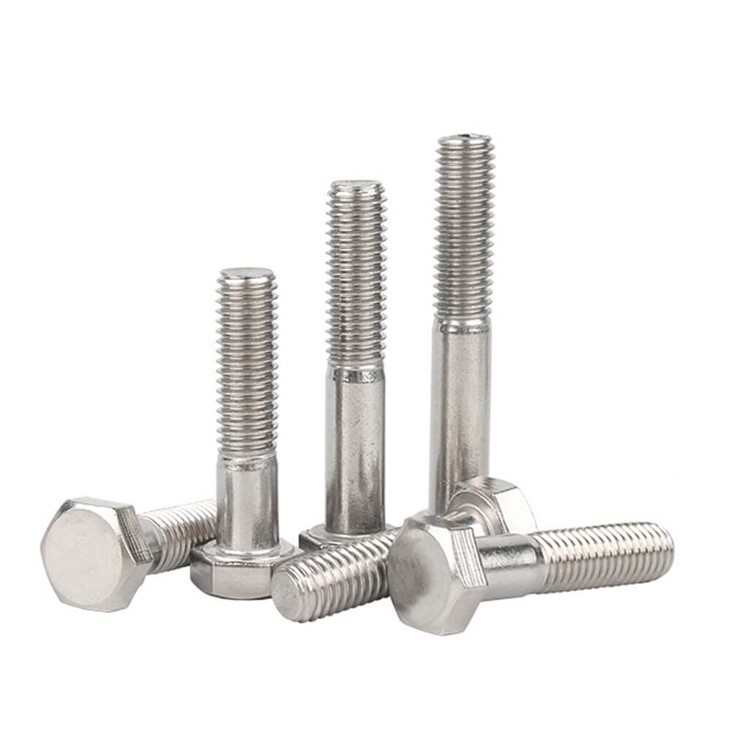
As a titanium bolt supplier, I've seen a wide range of applications for our Titanium Half Thread Hexagon Bolt. These bolts are very versatile, and the right coating can really enhance their performance. Whether you need a coating for corrosion protection, reduced friction, or improved appearance, we can help you find the best option.
If you're in the market for titanium bolts and are unsure about which coating is right for your application, don't hesitate to reach out. We have a team of experts who can provide you with more information and help you make the right choice. Contact us to start a conversation about your specific needs and let's work together to find the perfect titanium bolts with the ideal coating for your project.
References
-ASM Handbook Volume 5: Surface Engineering.
- Corrosion Basics: An Introduction by Mars G. Fontana.
- Handbook of Coating Technology by Peter P. Kuo.