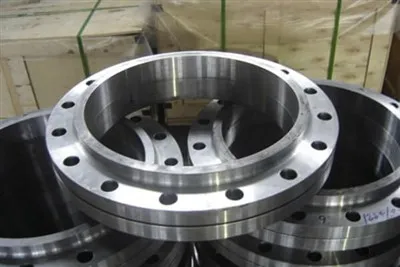


A flat weld flange is a flange connected to a container or pipe by a fillet weld. It can be any type of flange. Depending on the degree of integrity of the connection between the flange ring and the straight section, the design is checked as an integral flange or a loose flange. Compared with butt-weld flanges with necks, flat-weld flanges have a simpler structure and save materials, but their joint performance is not as good as butt-weld flanges with necks. A flat welding flange is a relatively high-quality flange product, which reduces the mass and space of the flange and plays an important role in industrial applications.

Application fields of Titanium alloy plate flat welding flange
A titanium alloy plate flat welding flange is widely used in the connection of medium- and low-pressure containers and pipelines and is suitable for pipeline connection with a nominal pressure not exceeding 2.5 MPa. The sealing surface of the flat weld flange can be made into a smooth surface, a concave and convex surface, and a grooved surface. Smooth, flat weld flanges are the most widely used. Mainly used for medium conditions, such as low-pressure unpurified compressed air or low-pressure circulating water.
Plate-type flat welding flanges are widely used in piping systems in chemical, petroleum, natural gas, power generation, water treatment, and other industries.
Flat welding flange: simple structure and main features
A titanium alloy plate flat welding flange acts as a connector between containers or pipes through fillet welds. When designing, engineers evaluate the integrity of the connection between the flange ring and the straight cylindrical segment, classifying them as either integral or loose flanges. There are two types of flange rings: with or without a neck. Compared with weld neck flanges, flat weld flanges have a simpler structure and use less material, but they may compromise on rigidity and sealing performance. These features make flat welding flanges suitable for connecting low-pressure to medium-pressure vessels and pipelines.


A titanium alloy plate flat welding flange is a type of flange commonly used in pipeline connections. It is usually used to connect two pipes or a pipe and equipment to ensure safe fluid transmission and prevent leakage. The plate-type flat welding flange has the following characteristics:
Flat Appearance: These flanges are usually flat with no raised necks or protrusions. They are usually designed to be flat, round, or square to fit flush with the connecting surface of the pipe or equipment.
Welding connection: The plate-type flat welding flange is connected to the pipeline or equipment by welding. Welding is generally carried out on the contact surface between the flange and the pipeline to ensure a firm connection.
Material selection: This type of flange can be made of a variety of materials to meet the requirements of different working conditions, such as titanium alloy, zirconium alloy, stainless steel, etc.
Flange type: Plate flat welding flanges usually have various flange types, including flange hole type (usually with bolt holes for bolt connection), flange face type (usually flat, but can also have special shapes), flange size (selected according to pipe diameter and wall thickness), etc.

Distinguishing features and precautions
The difference between a flat weld flange and a weld neck flange:
1. Scope of application: Slip-on flanges are widely used in low-pressure to medium-pressure carbon steel pipelines, while butt-weld flanges are suitable for high-pressure and high-temperature applications, including the transportation of expensive or flammable media.
2. Welding method: Flat welding flange only needs single-side welding, and no internal joint is required between the pipe and the flange. Butt-weld flanges require double-sided welding to reduce stress concentration.
3. Price difference: Due to the simpler manufacturing process, slip-on flanges are generally more cost-effective than butt-weld flanges.
4. Structural design: The butt-weld flange has a complex bell-shaped structure, while the flat-weld flange uses a gasket and is made into a ring with specific material strength and plastic deformation capacity.
5. Structural complexity: The design of the flat weld flange is less complicated and uses less material, but the rigidity and sealing performance may be worse than that of the butt weld flange.

FAQ
Q: Are you trading company or manufacturer ?
Q: How about your price?
Q: Could you provide free samples?
Q: What's your Delivery Time?
Q: How should I order and make payment?
Hot Tags: titanium alloy plate flat welding flange, China titanium alloy plate flat welding flange manufacturers, suppliers, factory, relief valve flange, motor flange, anodized flange, epoxy coated flange, construction flange, cast flange